
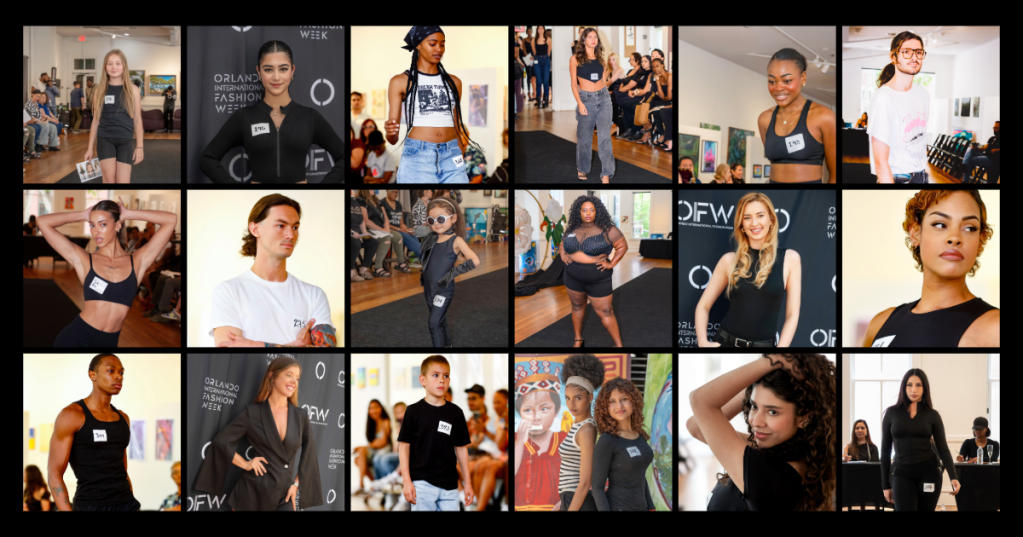
At Orlando International Fashion Week (OIFW), the runway does not begin on show day. It begins at casting.
Over two weekends this April, OIFW welcomed hundreds of aspiring and experienced models to CityArts Gallery in Downtown Orlando for official casting calls ahead of the June 6 runway shows. What unfolded was more than an audition process. It was a carefully designed experience rooted in a powerful truth: when people feel seen, supported, and welcomed, they are more likely to show up with confidence.
From first-time participants to returning talent, families, creatives, and industry professionals, the casting experience reflected what makes OIFW different. It was not just about selecting models. It was about creating a space where people felt confident enough to try.
Belonging First, Performance Second
In educational psychology, belonging is not a soft concept. It is a driver of motivation, persistence, and self-efficacy. Research in postsecondary education has consistently linked students’ sense of belonging to academic outcomes, engagement, and persistence (Fong et al., 2024; Gopalan & Brady, 2020). While OIFW is not a classroom, the same human principles apply. People perform differently when they feel safe, valued, and connected.
This also aligns with my doctoral research on online first-generation college students. In that study, participants described virtual extracurricular activities as affirming spaces that supported leadership development, motivation, self-efficacy, and belonging (Henlon, 2025). The findings affirmed that engagement spaces are not “extra.” They can be essential to how people build identity, confidence, and persistence.
OIFW reflects this same principle in a creative industry setting. People come back because of how they are treated.
Designing a Confidence-Building Experience
The atmosphere inside CityArts Gallery was intentional.
Models of all ages and backgrounds moved through the casting process in a space that felt structured, supportive, and human. Team members gave clear direction, answered questions, and offered encouragement in real time. Families felt comfortable. First-time participants felt included. Returning models felt valued.
Those details matter.
Social Cognitive Theory suggests that individuals build confidence through observation, encouragement, and successful participation in meaningful environments (Bandura, 1986). When a model sees others walk, receive feedback, and try again, the room becomes a learning space. Confidence is not simply demanded. It is modeled, practiced, and reinforced.
That approach also connects to the modeling and fashion curriculum I developed for youth and emerging talent, where self-esteem, work ethic, body language, preparation, and reflection were built directly into the learning experience. The curriculum framed self-esteem as confidence in one’s own worth and abilities, while encouraging participants to celebrate success, develop talents, practice positive self-talk, and treat themselves well. That same foundation was visible at casting: confidence grows when people are given structure, encouragement, and room to develop.
A Creative Ecosystem in Motion
Casting weekends brought together more than models.
Photographers, videographers, designers, media professionals, artists, families, and community members shared the same creative space. More than 20 photographers and videographers were present capturing content, building portfolios, and documenting the energy of the experience. Florida National News was also on-site, conducting interviews and helping tell the story of the event.
This kind of creative ecosystem matters because learning and confidence often grow through participation, not observation alone. Research on connected arts learning emphasizes the importance of linking creative practice to supportive relationships, cultural relevance, and opportunity pathways (Peppler et al., 2022). In other words, creative spaces become more powerful when they connect people to each other and to what comes next.
At OIFW, casting is not hidden behind closed doors. It is visible, collaborative, and alive. This is where relationships are built.
Inclusion as Strategy, Not Statement
OIFW continues to prioritize an inclusive casting approach that welcomes models across ages, sizes, backgrounds, and experience levels. This is more than a value statement. It is part of the structure.
Research on organized activities shows that participation in supportive group settings can help young people build social capital, strengthen relationships, and develop confidence through meaningful interaction (Boat et al., 2024). Similarly, studies of extracurricular activities have found that participation can strengthen self-efficacy, identity, and skill development when activities are structured with purpose and support (Griffiths et al., 2021).
That is why inclusive casting matters. When a young person, a first-time model, or a returning participant sees a range of people welcomed into the process, the message is clear: there is room for you here.
For families, this creates trust.
For designers, it creates range.
For sponsors and media, it tells a deeper story.
For participants, it builds confidence.
Safety, Structure, and Trust
With a strong presence of youth participants, OIFW maintains clear expectations around professionalism, age-appropriate presentation, and safety. Families can trust that the environment is monitored, structured, and designed with care.
That trust is part of why participants return season after season.
In youth development research, positive experiences in organized activities are strongest when young people experience supportive relationships, clear expectations, and opportunities to build skills (Boat et al., 2024; Heath et al., 2022). OIFW’s casting model reflects that kind of intentional design. The goal is not only to prepare people for the runway. It is to help them feel prepared to step into the room.
More Than a Casting Call
What happened over these two weekends was not only about who made the runway.
It was about creating a space where people felt confident enough to try, supported enough to grow, and inspired enough to return. It was about helping participants move from nervousness to possibility. It was about making sure that the first step toward the runway felt welcoming, not intimidating.
Creative participation can support well-being, identity development, and self-expression, especially when the environment is inclusive and relational (Mak & Fancourt, 2019; Peppler et al., 2022). OIFW’s casting experience shows how arts and fashion spaces can function as confidence-building environments when they are designed with care.
That is the OIFW difference.
Confidence is not built through pressure alone. It is built through belonging, visibility, preparation, and meaningful interaction.
Looking Ahead
Orlando International Fashion Week continues to build toward its summer season:
May 16, 2026: Avant Garde Showcase at Orlando Fringe Festival
June 5, 2026: VIP Mixer at Morse Code Lounge
June 6, 2026: “626 Euphoria” Runway Shows at Winter Park Events Center
Tickets are available at www.OIFW.org.
About the Author
Dr. Jessica Henlon is an educational psychologist, executive consultant, speaker, and founder of Dr. Jessica Henlon Consulting Co. Her work focuses on building inclusive systems, programs, and events that foster belonging, engagement, wellness, creativity, and strategic leadership. With more than 26 years of experience in student development, community engagement, and talent cultivation, she partners with learning institutions, nonprofit organizations, creatives, and civic leaders to design experiences where people feel seen, supported, and empowered to grow.
References
Bandura, A. (1986). Social foundations of thought and action: A social cognitive theory. Prentice-Hall.
Boat, A. A., Poparad, H., Seward, M. D., Scales, P. C., & Syvertsen, A. K. (2024). The role of organized activities in supporting youth social capital development: A qualitative meta-synthesis. Adolescent Research Review, 9, 543–562. https://doi.org/10.1007/s40894-024-00235-1
Fong, C. J., Adelugba, S., Garza, M., Lorenzi Pinto, G., & others. (2024). A scoping review of the associations between sense of belonging and academic outcomes in postsecondary education. Educational Psychology Review, 36(4). https://doi.org/10.1007/s10648-024-09974-y
Gopalan, M., & Brady, S. T. (2020). College students’ sense of belonging: A national perspective. Educational Researcher, 49(2), 134–137. https://doi.org/10.3102/0013189X19897622
Griffiths, T. L., Dickinson, J., & Day, C. J. (2021). Exploring the relationship between extracurricular activities and student self-efficacy within university. Journal of Further and Higher Education, 45(9), 1294–1309. https://doi.org/10.1080/0309877X.2021.1951687
Heath, R. D., Anderson, C., Turner, A. C., & Payne, C. M. (2022). Extracurricular activities and disadvantaged youth: A complicated but promising story. Urban Education, 57(8), 1415–1449. https://doi.org/10.1177/0042085918805797
Henlon, J. (2025). Exploring the learning experiences of online first-generation college students participating in virtual extracurricular activities (Publication No. 32114979) [Doctoral dissertation, Capella University]. ProQuest Dissertations & Theses. https://www.proquest.com/docview/3217854749
Mak, H. W., & Fancourt, D. (2019). Longitudinal associations between ability in arts activities, behavioural difficulties and self-esteem: Analyses from the 1970 British Cohort Study. Scientific Reports, 9, Article 14236. https://doi.org/10.1038/s41598-019-49847-x
Peppler, K., Dahn, M., & Ito, M. (2022). Connected arts learning: Cultivating equity through connected and creative educational experiences. Review of Research in Education, 46(1), 264–287. https://doi.org/10.3102/0091732X221084322
 Empowering communities, nonprofit organizations, and learning institutions.