

Part 1: Navigating FAFSA Season and Financial Decision-Making
Every year, mid-October marks the height of FAFSA season, a time when college-bound students and their families tackle the Free Application for Federal Student Aid (FAFSA) in hopes of securing financial assistance. This process often brings a mix of excitement and anxiety, and for many, applying for aid is an emotional journey. Students may feel overwhelmed by the complexity of forms and the weight of financial decisions that could shape their college opportunities.
This first article in our two-part series addresses the emotional and practical challenges of FAFSA season. It highlights how building financial awareness empowers students in choosing a college and planning for the future. We explore tools like the U.S. Department of Education’s College Scorecard, the importance of understanding student loans and repayment, and the mental health aspects of taking on debt.
The Emotions and Challenges of FAFSA Season
n Filling out the FAFSA can be both practically challenging and emotionally charged. Students must gather tax documents, understand financial jargon, and meet deadlines, tasks that can be especially daunting for those without prior guidance, a situation common among first-generation college students (The Education Trust, 2024). Emotionally, there is a lot at stake. Students know that financial aid outcomes may determine where, or if, they can afford to go to college.
Stress, confusion, and fear of making mistakes are common feelings during this process. Recent reports describe “tremendous mental health strain” among students awaiting financial aid letters (The Education Trust, 2024). One study found that words like “uncertainty,” “confusion,” “anxiety,” and “fatigue” frequently appeared in student conversations about financial aid (Sinha et al., 2023). An essential first step is to acknowledge these feelings as valid. Feeling nervous means you care about your future.
Students are not alone. Counselors, teachers, and online resources are available to guide them through the FAFSA. By taking the process one step at a time and asking for help when needed, students can turn this stressful season into an empowering experience.Filling out the FAFSA can be both practically challenging and emotionally charged. Students must gather tax documents, understand financial jargon, and meet deadlines, tasks that can be especially daunting for those without prior guidance, a situation common among first-generation college students (The Education Trust, 2024). Emotionally, there is a lot at stake. Students know that financial aid outcomes may determine where, or if, they can afford to go to college.
Stress, confusion, and fear of making mistakes are common feelings during this process. Recent reports describe “tremendous mental health strain” among students awaiting financial aid letters (The Education Trust, 2024). One study found that words like “uncertainty,” “confusion,” “anxiety,” and “fatigue” frequently appeared in student conversations about financial aid (Sinha et al., 2023). An essential first step is to acknowledge these feelings as valid. Feeling nervous means you care about your future.
Students are not alone. Counselors, teachers, and online resources are available to guide them through the FAFSA. By taking the process one step at a time and asking for help when needed, students can turn this stressful season into an empowering experience.
Financial Awareness as Part of the College Decision
Financial awareness is a key component of thoughtful college decision-making. While it is easy to focus on rankings or campus life, understanding the financial fit of a college is just as important as the academic fit. That includes looking beyond sticker prices to consider net costs, projected borrowing, and long-term affordability.
Students from all backgrounds, and especially those from lower-income or first-generation families, benefit from early conversations about college costs and budgeting (BestColleges, 2023). Many young adults later wish they had learned more about loans and financial planning before starting college. A study of student social media posts found common expressions of regret, such as “I should’ve learned about budgeting,” with many reporting they did not fully understand the debt they were taking on (University of Georgia, 2023).
One practical strategy is to compare aid packages and calculate the net cost of attendance. If College A offers more scholarships than College B, it may be more affordable overall, even if its tuition is higher. Students can ask: “Which college gives me the education I want with the least financial burden?” Framing the decision in this way gives students agency and helps ensure that their college experience is both enriching and sustainable.
Using the College Scorecard for Informed Choices
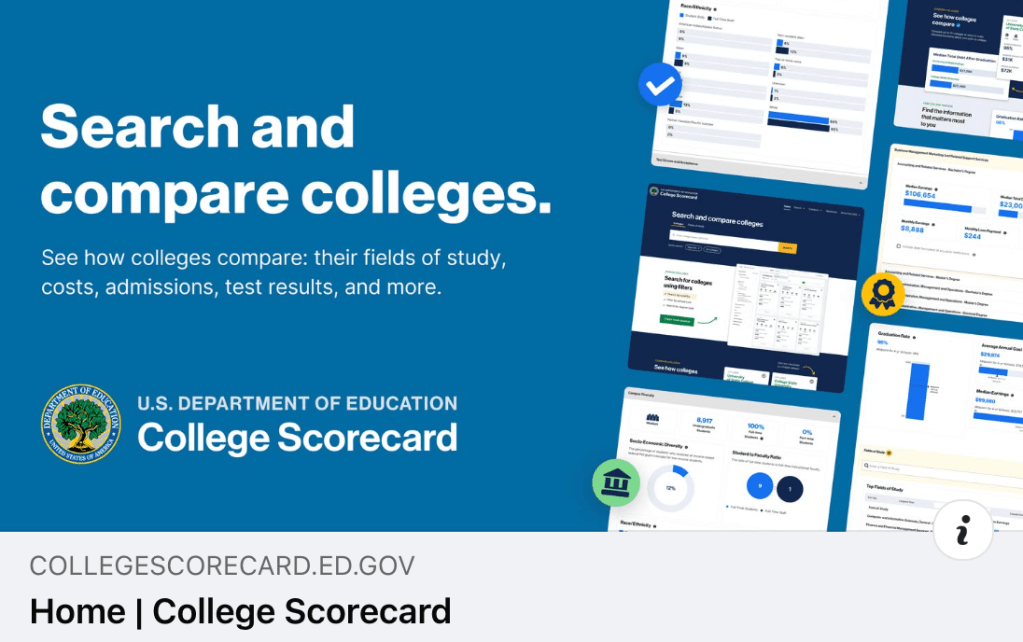
To make informed comparisons, students can turn to the U.S. Department of Education’s College Scorecard (https://collegescorecard.ed.gov). This free tool offers data on tuition, financial aid, graduation rates, average debt, and post-college earnings (Institute for Higher Education Policy [IHEP], 2023). Rather than relying on marketing materials or reputation alone, families can use real figures to guide decision-making.
For example, the Scorecard shows the average annual cost by income level, typical loan repayment success, and median earnings for graduates in different fields (IHEP, 2023). This information helps clarify the return on investment: Do graduates of this program earn enough to manage their debt? Are students likely to graduate and find stable employment?
By using the Scorecard, students might discover that one school has a higher graduation rate or that a particular major leads to more substantial earnings. Numbers are not everything, but they can help reduce uncertainty. Financial awareness is not about being overly money-focused; it is about protecting one’s future well-being. Using the Scorecard alongside academic fit and personal preferences helps students make decisions with complete confidence.
Student Loan Borrowing: Plan Before You Borrow
Many students borrow for college. The goal is not to avoid loans at all costs, but to use them intentionally. Federal student loans have flexible repayment plans and safety nets for low-income graduates (Bergland, 2023). Still, borrowing only what is needed and understanding the basics, like projected payments and career earnings, can reduce financial stress later.
Most undergraduates borrow modest amounts, with typical federal student loan balances ranging from $20,000 to $25,000 (Board of Governors of the Federal Reserve System, 2025). While six-figure balances tend to dominate headlines, they are rare among undergraduate borrowers (Hanson, 2024). Financial aid advisors and loan calculators can help students create realistic repayment strategies based on expected salaries. A thoughtful approach to borrowing supports both educational and emotional well-being.
The Emotional Burden of Debt: Mental Health Matters
Financial decisions also carry psychological weight. Studies show clear links between student debt and increased anxiety, depression, and cognitive stress (Walsemann et al., 2015; Bergland, 2023). These effects are especially pronounced among underserved or first-generation students, who may feel additional pressure or lack support systems (The Education Trust, 2023).
Acknowledging the emotional dimension of debt is essential. Colleges increasingly offer financial wellness workshops, counseling services, and mentorship programs that address both fiscal and mental health needs. Seeking help is a sign of strength. Education should empower, not overwhelm—and maintaining mental well-being is part of making the most of the college experience.
National Trends in Student Loans and Repayment
Understanding national patterns helps students place their personal finances in context. As of mid-2025, Americans owe approximately $1.8 trillion in student loans, but the majority of borrowers owe less than $25,000 (Education Data Initiative, 2025; Board of Governors of the Federal Reserve System, 2025). Repayment often extends beyond 10 years, especially for those using income-driven plans or returning to school.
Despite these long timelines, many borrowers successfully manage their payments. Federal policies such as the SAVE Plan offer income-based payment caps to support financial stability (Bergland, 2023). Students who complete their degrees and stay informed about repayment options tend to experience better outcomes.
A Call to Thoughtful Action
Financial awareness is not about fear; it is about empowerment. For college-bound students, developing a plan for paying for school is an investment in peace of mind. By approaching FAFSA season with curiosity, self-advocacy, and informed support, students can make decisions that serve both their academic dreams and their long-term well-being.
Part 2 of this series will explore how to make the most of college through career development, mentorship, and skill-building experiences that amplify the return on educational investment. Until then, students are encouraged to keep asking questions, seeking support, and remembering that taking ownership of their financial journey is a powerful form of self-leadership.
About the Author
Jessica Henlon, PhD, is an educational psychologist and researcher who supports first-generation and underrepresented students in navigating higher education. Her work focuses on college access, student belonging, and career development. She is the author of a dissertation on virtual extracurricular engagement and frequently contributes to conversations on financial empowerment in college planning.
References
Bergland, C. (2023, September 6). Saving on a Valuable Education (SAVE): Biden’s new income-driven student loan repayment plan. Scientific American. https://www.scientificamerican.com/article/save-bidens-new-income-driven-student-loan-repayment-plan/
BestColleges. (2023). First-generation college students: Facts and statistics. https://www.bestcolleges.com/research/first-generation-students-facts-statistics/
Board of Governors of the Federal Reserve System. (2025). Economic well-being of U.S. households in 2024 – Higher education and student loans. https://www.federalreserve.gov/publications
Education Data Initiative. (2025). Student loan debt statistics. https://educationdata.org/student-loan-debt-statistics
Hanson, M. (2024). Average student loan debt in the U.S. Education Data Initiative. https://educationdata.org/average-student-loan-debt
Institute for Higher Education Policy. (2023). College Scorecard: A guide for students and families. https://www.ihep.org
Sinha, G. R., Larrison, C. R., Brooks, I., & Kursuncu, U. (2023). Comparing naturalistic mental health expressions on student loan debts using Reddit and Twitter. Journal of Evidence-Based Social Work, 20(5), 727–742. https://doi.org/10.1080/26408066.2023.2202668
The Education Trust. (2024, March 21). 2024–25 Better FAFSA advocacy FAQs. https://edtrust.org/blog/2024-25-better-fafsa-advocacy-faqs/
U.S. Department of Education. (2023). College Scorecard. https://collegescorecard.ed.gov
Walsemann, K. M., Gee, G. C., & Gentile, D. (2015). Sick of our loans: Student borrowing and the mental health of young adults in the United States. Social Science & Medicine, 124, 85–93. https://doi.org/10.1016/j.socscimed.2014.11.027
 Empowering communities, nonprofit organizations, and learning institutions.