
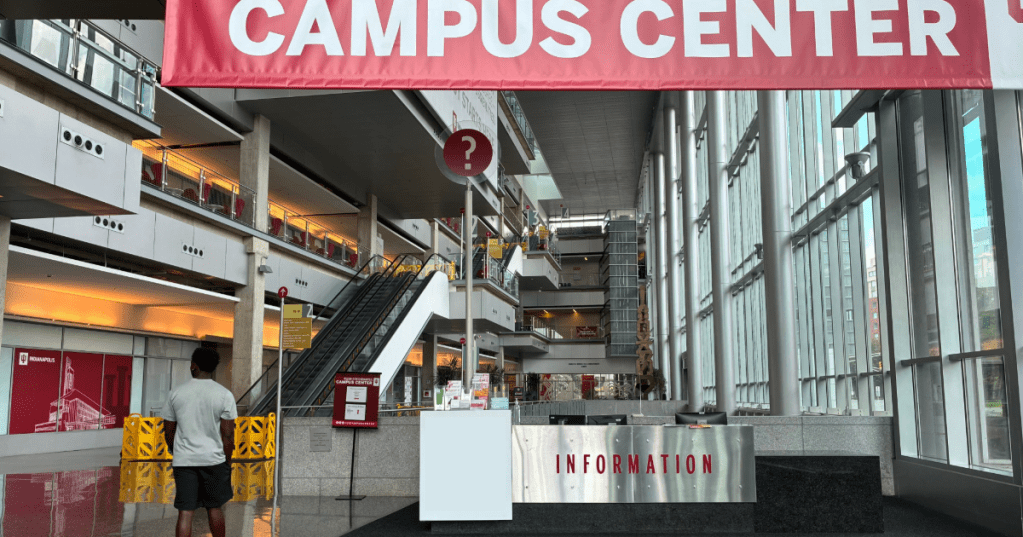
Walking through quiet campuses this August: Purdue Fort Wayne, Indiana Tech, the University of Indianapolis, Butler, and IU Indianapolis, I found myself reflecting on what signals true student belonging. It wasn’t just the buildings or new labs. It was the career closets tucked inside student centers, the mandatory study halls for athletes, the bulletin boards overflowing with club flyers. Each of these details spoke to a more profound truth: belonging is designed into the student experience.
Preparing Students for Careers and Confidence
At Purdue Fort Wayne, I walked by signs for the Mastodon Career Closet, where students can borrow free professional attire for interviews. Similar initiatives at Indiana Tech and UIndy included career advising and internship pipelines that connected students directly to local employers. These resources matter because research shows students who receive early guidance are more likely to persist and complete their programs (Bailey et al., 2015; Jenkins & Lahr, 2022).
Supporting Student-Athletes Beyond the Game
At IU Indianapolis and Indiana Tech, athletes must complete supervised study hours, while Butler ties academic check-ins to weekly study tables. This proactive approach supports athletes succeeding in the classroom as well as on the field. Research confirms that structured accountability, such as mandatory study halls where student‑athletes work with advisors to set specific goals, enhances self-regulated learning and strengthens academic persistence among athletes (Schwartz, 2018).
Creating Safe and Supportive Spaces
Every campus I visited had visible safety signage, such as emergency call boxes, and centrally located counseling centers. These visible markers of care make families feel reassured and give students the confidence to engage fully in their education.
Engagement That Sparks Connection
From robotics clubs to cultural associations, bulletin boards across the campuses advertised countless ways to belong. Bandura’s Social Cognitive Theory (1986) reminds us that students learn from observing peers; when students see others involved, they are more likely to engage themselves.
The Research Connection
My dissertation (Henlon, 2025) found that online first-generation students described virtual extracurricular spaces as vital to their sense of belonging and persistence. These findings mirror what I saw in Indiana: structured opportunities for connection build confidence and motivation.
A new study by the Community College Research Center supports this. Lahr et al. (2025) found that while most incoming students felt “certain” about their first-choice major, many were still considering multiple careers at once. Without clear support, students defaulted into general studies programs with weak labor market outcomes. But with visible guidance—career centers, advising, and tutoring, students were more likely to choose programs aligned with their long-term goals.
“Belonging is not optional. It is foundational.”
Call to Action
Families: when you visit campuses, look for signs of belonging. Where are the tutoring labs? Are career services visible? Do bulletin boards reflect a range of student interests? These details matter.
Institutions: design intentionally. Invest in high-impact supports, career programming, tutoring, mentorship, and make them visible. Students who feel seen and supported are more likely to stay, graduate, and lead.
Belonging makes the difference, not just for students but for the communities they will one day serve.
References
Allen, J., & Robbins, S. (2010). Effects of interest–major congruence, motivation, and academic performance on timely degree attainment. Journal of Counseling Psychology, 57(1), 23–35. https://doi.org/10.1037/a0017267
Bailey, T., Jaggars, S. S., & Jenkins, D. (2015). Redesigning America’s community colleges: A clearer path to student success. Harvard University Press. https://doi.org/10.4159/9780674425934
Bandura, A. (1986). Social foundations of thought and action: A social cognitive theory. Prentice-Hall.
Deci, E. L., & Ryan, R. M. (2000). The “what” and “why” of goal pursuits: Human needs and the self-determination of behavior. Psychological Inquiry, 11(4), 227–268. https://doi.org/10.1207/S15327965PLI1104_01
Henlon, J. (2025). Exploring the learning experiences of online first-generation college students participating in virtual extracurricular activities (Publication No. 32114979) [Doctoral dissertation, Capella University]. ProQuest Dissertations & Theses. https://www.proquest.com/docview/3217854749
Jenkins, D., & Lahr, H. (2022). Research evidence on community college Ask-Connect-Inspire-Plan onboarding practices. Community College Research Center. https://ccrc.tc.columbia.edu/publications/ask-connect-inspire-plan-onboarding.html
Lahr, H., Minaya, V., Baker, R. B., & Delgado, P. L. (2025). How do incoming community college students think about programs of study and potential careers? Community College Research Center. https://ccrc.tc.columbia.edu/publications/community-college-students-program-study-career.html
Schwartz, S. M. (2018). Football study hall and self-regulated learning (Doctoral dissertation, Purdue University). Purdue University. https://docs.lib.purdue.edu/open_access_dissertations/1824
Strayhorn, T. L. (2019). College students’ sense of belonging: A key to educational success (2nd ed.). Routledge.
Tinto, V. (1993). Leaving college: Rethinking the causes and cures of student attrition (2nd ed.). University of Chicago Press.Tracey, T. J. G., & Robbins, S. B. (2006). The interest–major congruence and college success relation: A longitudinal study. Journal of Vocational Behavior, 69(1), 64–89. https://doi.org/10.1016/j.jvb.2005.11.003
 Empowering communities, nonprofit organizations, and learning institutions.